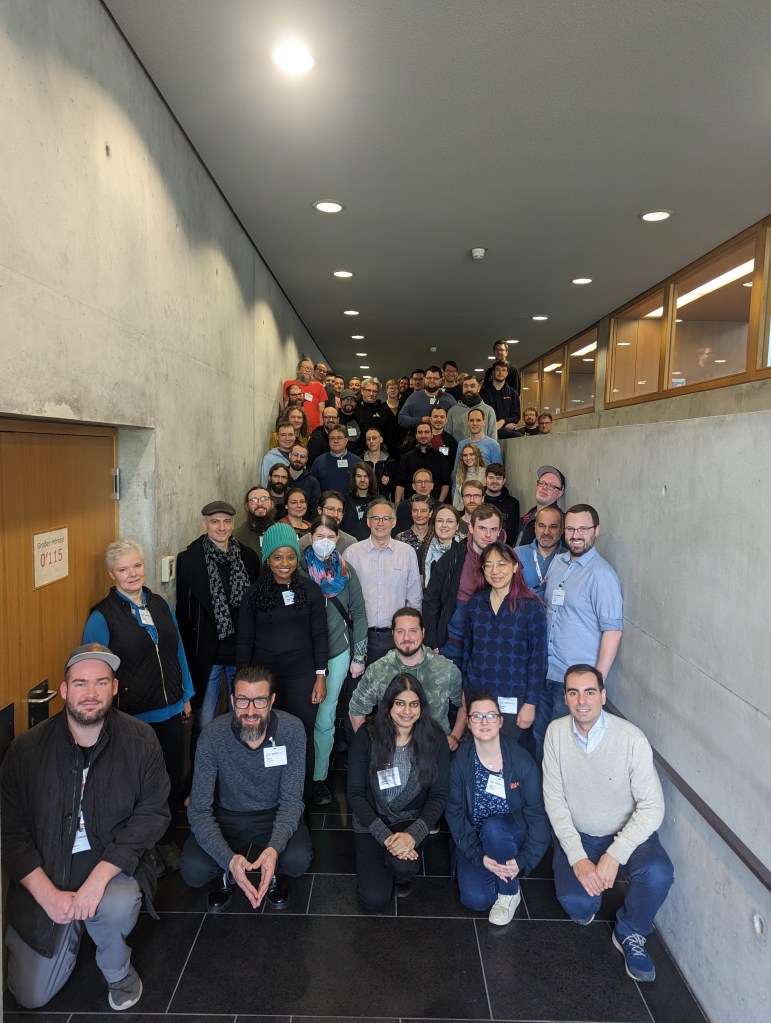
Admin Interface BugBash on June 4-5, 2024

The new admin interface has a bunch of minor, but still very annoying
bugs. To address this, there will be an Opencast BugBash focused on
the new interface (though no one will complain if you fix other bugs).

The idea for these two days is to bring together as many people as possible to identify bugs, fix them and review the resulting patches so that we can get them into Opencast prior to the release of Opencast 16.

If you want to help, that would be great. We need…

  • admins and users testing the new user interface to create issues
  • developers to fix issues and create pull requests

To participate just show up at the meetings, visit our Matrix channel at #opencast-community:matrix.org or just work in GitHub.

You cannot make it but want to help regardless?

  • You can already start identifying problems and file them as an issue. Please also file usability issues, or other suggestions for improvements.
  • You can put money into hiring developers from the usual suspects when
    it comes to experience with Opencast development.
  • You can help to translate the admin interface on Crowdin.

Affordable hotel options for the 2024 Opencast summit

Thanks to our host Javi, we can offer you the following affordable hotel options; please mention our meeting when making a reservation:

ZENIT DON YO **** 65,97 €

Juan Bruil 4-6. 50001 ZARAGOZA / Tfno.: +34 976 226741

Single occupancy room, breakfast and VAT included.

HOTEL ALFONSO **** 65,97 €

C/ Coso, 15-19 50003 ZARAGOZA/Tfno.: +34 876 541118

Double room for single use, breakfast and VAT included.

HOTEL GOYA **** 65,97 €

C/ Cinco de marzo,5 50004 ZARAGOZA/Tfno.: +34 976 22 93 31

Double room for single use, breakfast and VAT included.

VINCCI ZARAGOZA ZENTRO **** 65,97 €

C/ Coso, 86 50001 ZARAGOZA/Tfno.: +34 976 703300

Single occupancy room, breakfast and VAT included.

HOTEL NH SPORT *** 62,15 €

C/ Moncayo ,5 50010 ZARAGOZA/Tfno.: +34 976 311114

Double room for single use, breakfast and VAT included.

ZARAGOZA ROYAL *** 65,97 €

C/ Arzobispo Domenech, 4-6 50006 ZARAGOZA / Tfno.: 976 214600

Single occupancy room, breakfast and VAT included.

HOTEL RIO ARGA **

Contamina, nº 20. 50003 ZARAGOZA / Tfno.: 976 399 065

Single occupancy room, breakfast and VAT included. 60,00 €

Double room, breakfast and VAT included. 77,00 €

Parking €/day 17,00  €

Opencast 15.0

Hi everyone,

it is my pleasure to announce that Opencast 15.0 has been released:

The documentation for this release can be found at:

Please make sure to read and follow the upgrade guide carefully when upgrading from an older major version to Opencast 15.

RPM and Debian packages as well as Docker images will be available soon. Watch for announcements on the users list.

To all committers and involved contributors, thank you for all your work. This could not have happened without you, and we are glad we were able to work together and get this release out.

Best Regards

Release Managers Opencast 15.0
Berthold Bußkamp
Arne Wilken

2023/2024 Roadmap

As board, we talked to several members of the community about projects, efforts, and plans they have for Opencast in the near future, so that we could integrate them into a roadmap we would like to share with you.

Most of these projects are expected to be finished in early 2024 and will likely make it into Opencast 16. However, maybe one or two will make the Opencast 15 cut?

Auto-Update Metadata

We all know the situation: Someone changed a video title in Opencast and then complains that the player still shows the original title. The answer: Did you run the workflow to republish metadata? Users do not understand that saving a new title is not enough.

That said, is it even reasonable to expect users do understand the additional step required? Looking at how Opencast works and is being used, probably not. That is why we would like to make it possible for Opencast to automatically update the publication when you update metadata or access rights.

This should help users, make editing data faster and lead to fewer mistakes when updating metadata when editing data manually. It should also make integrations simpler since you don’t need to make sure to run additional steps and you no longer have a blocking component (workflow) for updates.

This project is driven by Osnabrück University. Our estimated timeline for this is to have it done by the end of the year.

Update To The Editor

Updating the editor is part of the ongoing crowdfunding campaign. It will fulfil some long-lasting needs: Finally, one will be able to up- and download subtitles in order to use them outside Opencast. Or edit them manually and re-upload them. Also, the “remove all segments” feature and the timeline zoom will become available.

These new features will also be accompanied by a number of fixes to bugs and other issues we have collected lately.

Lifecycle Management

This feature is driven by two requirements: One is to help lecturers use recordings more flexibly: Don’t publish them right away, but at the end of the semester. Or at a given time. Or with a delay to the recording date. In order to serve these requests efficiently and reliably, Opencast requires additional metadata and/or workflows. The second requirement comes from the other end of the publication: Please unpublish (or delete) these recordings at the end of the exam season. Or, from an institutional perspective: Unpublish all lecture recordings two years after they were produced. But inform lecturers in advance. And delete them from the archive after five years. Again, metadata and workflows will help you meet these needs.

Playlists

In Opencast, we already have series to group a bunch of videos and put them (for example) into a course. But this concept is fairly restrictive. What if I have an introduction video I want to put into several series? The answer right now: Upload it to Opencast again or clone it. That’s not a great solution.

This and more has let us believe that it is time to introduce the new concept of playlist to Opencast. Playlists are a list of videos, similar to the same concept on YouTube. This provides an n:m mapping, meaning that every playlist can contain multiple videos, and each video can be included in multiple playlists.

Part of the project is that it should be easy for integrations like LMS plugins (Moodle, Stud.IP, ILIAS) or video portals (Tobira, WordPress) to take these lists and render them.

The project is driven by TU Wien and Osnabrück University. We hope to have this finished in time for Opencast 16 in early 2024.

Integration of Whisper

The idea is to have an on-premise, open source transcription service in Opencast. This is an alternative to the existing integrations with AmberScript, Microsoft and others. As an on-premise solution, this is also more data protection compliant (keyword GDPR).

One part of the project is to have a Whisper integration for both GPU and CPU. This allows institutions – like us at the moment – without GPU server infrastructure to still easily use this feature.

Another aspect of this project is that lecturers should be able to initiate subtitling in different languages via the LMS (we use Moodle), e.g. by starting a corresponding workflow from the block plugin, uploading or downloading subtitles, deleting them again if necessary, or being able to post-process them via the Opencast Editor.

The basis should of course be that the subtitles are saved as tracks, so that it is possible for the lecturers to cut a video and thus also the subtitles, so that they always remain in sync.

Right now, we are testing openai-whisper and whipser-ctranslate2. The latter is optimized for CPU usage. There is already a pull request from Martin (ELAN e.V.) for improving the speech to text engine.

If there are other approaches, like the WhisperC++ pull request, that might be easier to integrate or where the creation of subtitles is faster, we would be happy to hear from you.

The project is driven by HU Berlin and with the support and developed by ELAN e.V. We hope to have this finished in time for Opencast 16 in early 2024.

Remove Solr and New Search

The Solr index is what powers your users’ ability to find videos. Our integration works, but has not been maintained in years, and it is starting to show. With the last round of crowdfunding, we decided to replace the existing Solr implementation with one based on Elasticsearch/Opensearch – the same technology powering the rest of the indexes in Opencast.

The basic skeleton of the required changes is already complete, however there is still work to be done, and extensive testing with real-world data is definitely something we want to do prior to pushing this out to adopters! Because of this we are pushing the target release from Opencast 15, to Opencast 16.

Thanks to funding from the University of Stuttgart, we expect this work to be complete sometime in December for inclusion early in the Opencast 16 release cycle.

Video Portal

The active development of Tobira is currently mostly about many incremental improvements, small new features, and bug fixes. A few notable plans include: the ability to set and modify access permissions (ACLs), to delete videos, and modify metadata of videos, and also to set access rights on pages.

SysAdmin Meeting replaces Adopter Meeting

As interest in the international and German-speaking Adopter’s meetings wanes, multiple people at the last Opencast DACH conference have expressed the need for a meeting that goes more into depth in regards to the technical details, but also isn’t as development-focused or time-consuming as the weekly Technical Meeting, as well as a meeting time that is more comfortable for Europeans.

Therefore we are happy to report that the first monthly SysAdmin meeting will happen at the 25th of October at 3pm CEST, so Wednesday next week, at https://meet.opencast.video (password is “welcome”). This will replace all Adopter’s meetings for the foreseeable future (though it is planned to hold a special meeting every 6 months where the new major release of Opencast will be presented).

The target group of this new meeting will primarily consist of people administrating their own Opencast instances or who are interested in doing so, though some Opencast developers will also be present. The focus of the first meeting will be to develop the structure of this new meeting. The following topics of interest were already proposed:

1. A short overview of current information helpful to sysadmins like known problems, security issues, whether a fast update to the next minor update is advised etc.

2. Information on ongoing development projects in the community or major changes to Opencast that are planned.

3. Presentation of a selection of open pull requests where reviews or testing are needed, or changes that might be controversial where more input is required.

4. Coordination of testing efforts for new Opencast releases to increase quality.

This meeting is supposed to offer the opportunity for developers to get easy access to people actually running Opencast systems to confirm assumptions about usage or find someone who can test a specific integration, as well as a change for sysadmins to give feedback and discuss issues they are experiencing. For this we’re also considering to offer a space for discussions after the official part of the meeting is over.

Don’t hesitate to contact Katrin (ihler@elan-ev.de) or Freddy (vogt@elan-ev.de) if you have any questions or opinions.

Tobira 2.0 released

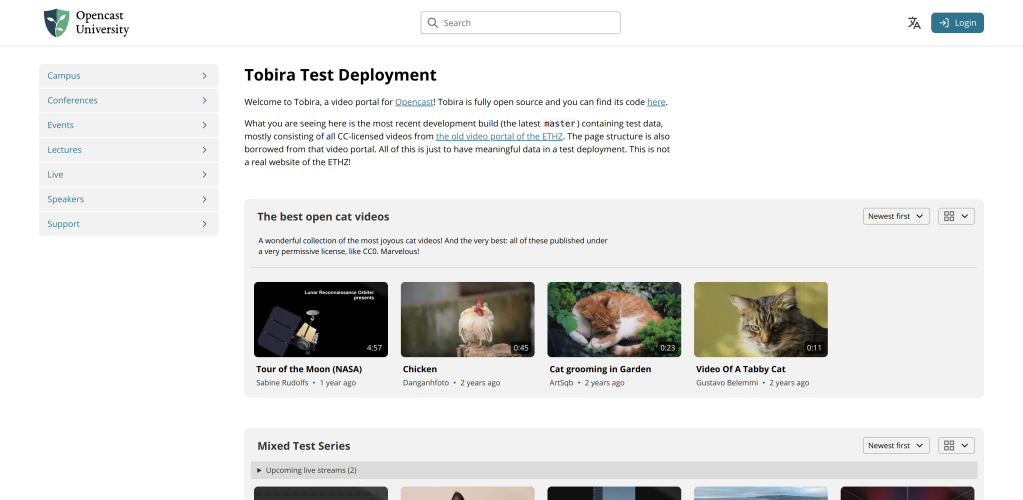
We are very happy to announce Tobira 2.0, the first major version after Tobira’s initial release in July last year. A lot has happened since then!

Tobira aims to be a pleasant interface through which users interact with your Opencast content. It lets you present videos and series in a customizable, hierarchical page structure, but also makes it easy for users to search through all media. Additionally, it offers tools to upload and manage videos. It’s possible to connect Tobira to virtually any authentication system and integrate it into your university’s/organization’s infrastructure.

The main changes in the 2.0 release include an extensive design refinement, user pages, being able to upload videos into series, a better share menu, a revamped color system, and a large number of accessibility improvements. User pages allow users (who are allowed to) to create and manage their own pages that are independent of the main page structure. The design changes don’t include anything major and the layout certainly stayed the same, but everything looks a lot tidier now.

You can read the full changelog of v2.0 on GitHub’s release page.

But there are 7 additional releases between 2.0 and 1.0, which brought a large number of features and improvements as well. The most notable ones are:

  • Properly support live-streams
  • Make videos nicely embeddable
  • Add subtitles support
  • Vastly improve documentation
  • Add metrics endpoint (e.g. for Prometheus)
  • Improved series & event block editor
  • Pre-authenticating users for Studio and Editor
  • Collapse/hide multiple upcoming events
  • Ease first-time setup considerably
  • And much much more!

And there are no signs of development slowing down!

As usual, we would like to thank all institutions which make Tobira possible by funding its development. This is primarily the ETH Zürich which is the project’s primary patron and has been from the very start. We are also very grateful for the significant contributions by Bern university and the TU Wien.

The State of Education Video

You heard it first at the Opencast summit in Berlin, so it comes as no suprise that commercial lecture capture solutions are becoming a financial burden to universities, especially in the aftermath of the pandemic explosion of video content. What is a surprise is the fact that Opencast receives an honourable mention in the respective article from streamingmedia.com, being described as “the venerable and well-maintained Opencast (née Opencast Matterhorn) open source video platform”. Blush.

2023 Opencast summit: Annexe

After a three-year hiatus, the Opencast community was finally able to come together in person for their annual summit at Humboldt-Universität zu Berlin in March. More than 60 people joined, the programme was packed and the backlog for informal communication was reduced, but not resolved. Next stop: Bern in August for the German-speaking community. Go to https://video.ethz.ch/events/opencast/2023/berlin.html for recordings.