As board, we talked to several members of the community about projects, efforts, and plans they have for Opencast in the near future, so that we could integrate them into a roadmap we would like to share with you.
Hello New Admin Interface
While we have been talking about it for a while, early 2023 should finally reveal the new admin interface.
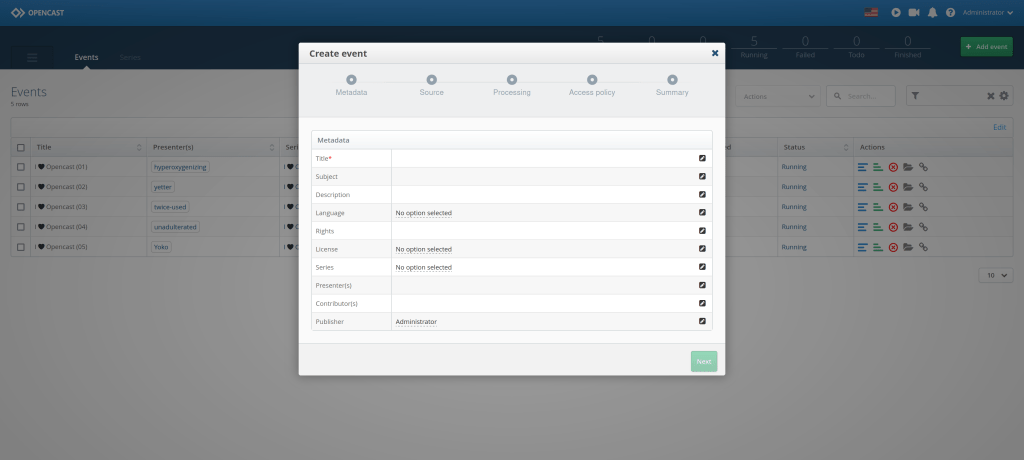
But hold on… doesn’t it look kind of… identical? Yes, it does.
The main goal of this effort spearheaded by the University of Stuttgart is to replace the obsolete foundation we built on. Web technology has evolved over the years and what was state-of-the-art in 2014 when the current admin interface was conceived is remembered by few gray-bearded old developers today.
The new implementation allows us to fix some problems and makes it easier to build on the current foundation. This should hold true, especially for new developers.
Opencast Studio: Bug-bash
Opencast Studio was released in early 2020 and immediately saw very heavy usage during the pandemic.
But over the last couple of years, a number of minor issues came up and have been recorded in the issue tracker. These issues were not important enough for someone to immediately fix them, but they still contain lots of good ideas.
That is why we will review them and try to fix as many as possible in one big update.

Opencast Studio: Desktop Audio
Opencast Studio allows you to easily record your camera, desktop, and microphone. Unfortunately, desktop audio is missing. You want to play a short video and include that? No audio. You want to show someone how screen readers work? No audio.
In 2023, we would like to change that and again tackle the issue of recording desktop audio. This was hard with browsers in 2020, but technology has improved since then, and we hope that we can now make this happen.
Opencast Studio: Camera Blur
A lot of video conferencing tools allow users to automatically blur the background to hide their personal spaces.
We hope to transfer this technology to Opencast Studio in the first half of 2023 and include this in a later Opencast 13 or 14 release.
Tobira in Action
Due to the growing number of adoptions, early 2023 will be a lot about “refinement” for Tobira.
Specifically, there will be a focus on improving the design and accessibility across the entire application. But also more concrete features like the uploader offering more control over the content, or the video page giving more details and sharing options to the user.
Another area of focus is the search, which will incorporate more metadata like subtitles, for example. We are also thinking about how we can meaningfully integrate statistics for both, producers and consumers, and user-generated content.

Documentation Overhaul
One of the best things about Opencast 2 was the new documentation. No more reading through several wikis in the hope that somewhere someone wrote down something about what you want to know. Everything started to be at one place, you could easily switch between different versions and there was no longer an excuse for developers to not provide documentation alongside their patches. Not that an Opencast developer would ever not write nice documentation, of course…
Still, our documentation is getting old. Priorities have shifted. Functionality that has been purely optional in the past has become an integral part of Opencast. Some deployment options are mentioned but not properly explained. Some functions are no longer supported. You have all seen some of these problems pop up here and there.
That is why we set out to focus on a big overhaul of the Opencast documentation for Opencast 14. Having better documentation should help us all.

Goodbye and good riddance Solr
Solr is one of the search indexes used by Opencast. It is very old and has already been replaced in most places as part of last year’s crowdfunding. As part of that, we also built a prototype of a Solr-free search service, which is the last part using Solr.
While the prototype works, we have to be careful when replacing this part in Opencast since the publications players and many integrations depend on this. That is why we turned this into a separate project for early 2023.
The advantage of getting rid of this final Solr is that we can make both the admin and the presentation nodes redundant easily. That is great in terms of high availability. Additionally, we will also fix a few minor security issues along the way.
Advanced Storage Backend for Archive
The asset manager is the central storage for Opencast recordings and can contain both source and processed video material as well as additional files like metadata catalogs, subtitles or preview images.
With the growth of Opencast instances over the last couple of years, the need for asset manager storage has also increased significantly for many adopters. This led to problems due to storage system limitations.
To address this issue, the asset manager will get an updated storage backend that allows adopters to split the storage between different backends. This allows for far more flexibility and a seamless extension of existing storage.
The target release for this new feature is Opencast 15.
Subtitles as First-Class-Citizens
Subtitles have been a topic in Opencast for the last couple of years. New integrations with cloud transcription services have been added, free open source tools have been integrated and the new editor now has a subtitle editor for users to improve subtitles themselves.
While Opencast now has many tools, what is still missing is a coherent integration and a workflow easy to use for all users. The community has expressed sufficient interest in subtitles that the default workflow will automatically include support for subtitles (uploads, editing, …), so you no longer have to configure this yourself.
Doing this is part of an ongoing effort for Opencast 14.
 Opencast