Vom 23. bis 25. September findet in Bremen das deutschsprachige Opencast Community Treffen statt. Die Teilnahme an der Veranstaltung ist kostenlos inkl. Pausenverpflegung. Wir freuen uns über eure Anmeldung. Bitte beachtet, dass wir am Montagabend mit einem informellen Treffen und einer kleinen Besichtigung der Infrastruktur beginnen und das Hauptprogramm am Dienstag starten wird.
UNIVERSITÄT BREMEN
Hey, wir freuen uns die Opencast DACH Konferenz 2024 veranstalten zu dürfen. Für die Tagung haben wir Räumlichkeiten auf unserem Campus gebucht, den ihr grundsätzlich unter der Adresse Bibliothekstraße 3, 28359 Bremen erreichen könnt.
Die Parkgebühren betragen 1€ pro Tag und das Ticket kann 24/7 an einem der Automaten bezahlt werden. Den Weg zu den Räumlichkeiten der Tagung werden wir ausschildern.
Anreise ÖPNV
Für eine Anreise mit dem ÖPNV bitten wir euch als Zielhaltestelle „Bremen Universität/Zentralbereich“ anzusteuern. Dies ist die zentrale Haltestelle auf dem Campus, von wo aus der Weg zu den Räumlichkeiten der Tagung ausgeschildert sein wird.
Vom Bremer Hbf fährt zum Beispiel in einer angenehm häufigen Taktung die Linie “6 Universität” innerhalb von 15 Minuten bis zum Zentralbereich.
RÄUMLICHKEITEN
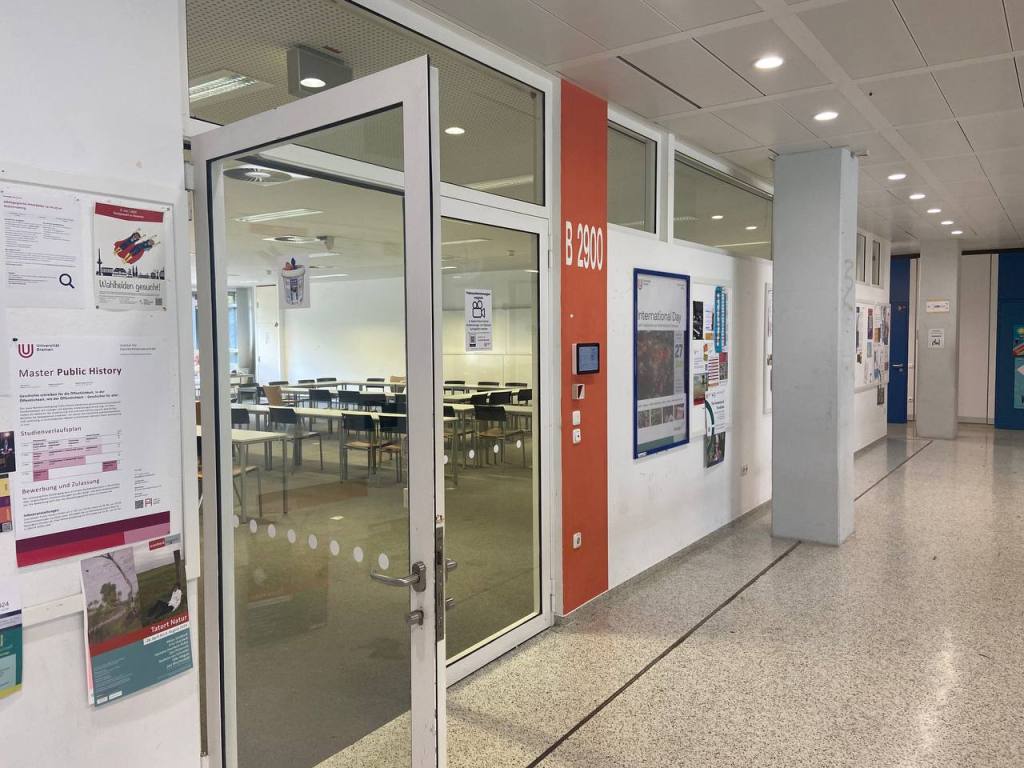
Die Wege zu den Räumlichkeiten werden wir großzügig ausschildern. Für Montagabend haben wir einen Raum im Gebäude SFG gebucht. Für Dienstag und Mittwoch werden uns 3 nebeneinanderliegende Räume im Gebäude GW2 zur Verfügung stehen. Wir werden euch auch eine bewachte Garderobe anbieten, sodass ihr zum Beispiel am Abreisetag entspannt schon das Gepäck mitbringen könnt.
Grundsätzlich ist Bremen eine Stadt, in der die Wege nicht weit sind und das ÖPNV Netz sehr gut ist. Auch gibt es hier die allseits bekannten E-Roller und gute Fahrradwege. Ein Blick in den DB-Navigator vor der Buchung wird euch wahrscheinlich bei den meisten Hotels für die Zielhaltestelle „Bremen Universität/Zentralbereich“ eine vertretbare Anreisezeit anzeigen, grundsätzlich können wir aber auch insbesondere die Hotels in Uni Nähe empfehlen:
Hotel Munte am Stadtwald**** Parkallee 209, 28213 Bremen www.hotel-munte.de
Beim Hotel 7THINGS kann für einen Rabatt bei telefonischer Buchung „Universität Bremen“ als Stichwort angegeben werden. (Aber: Der Preis ist am Ende nicht unbedingt billiger als z. B. über Booking)
KONTAKT
Kontaktperson für die Veranstaltungsorganisation in Bremen:
Weitere Informationen im Detail folgen mit Veröffentlichung des Rahmenprogramms zu einem späteren Zeitpunkt in einem separaten Post.
Vielen Dank
Wir danken der Manfred und Ursula Fluß-Stiftung für Ihre Unterstützung, diese hat maßgeblich zu einer reibungslosen Planung und Durchführung beigetragen. Wir freuen uns nun darauf, die Opencast DACH Community an der Universität Bremen willkommen zu heißen.
Um euch eine frühzeitige Planung zu ermöglichen: Wir treffen uns am 23. September 2024 um 18 Uhr auf dem Campus der Universität Bremen, Bibliothekstraße 1, 28359 Bremen. Montag ist Anreise und Besichtigung der Infrastruktur der Kollegen in Bremen, am Dienstag und Mittwoch beginnen wir jeweils um 9 Uhr; die Teilnahme ist kostenlos.
Bitte meldet euch so bald wie möglich an, damit wir die notwendigen Planungen vorantreiben können; diese Anmeldung ist verbindlich und Voraussetzung für die Teilnahme!
Für die inhaltliche Vorbereitung suchen wir Freiwillige, die das Programm zusammenstellen. Meldet euch bitte direkt bei Rüdiger.
We want to thank our hosts in Zaragoza at the Vice-rectorate for Digital Education and Continuing Education, and particularly to Javier Fabra (Director of Development and Digital Transformation).
We have a matrix channel to communicate about the summit
Welcome (15 min) – Olaf Schulte, ETH Zürich / Zaragoza University
10:15
Introduce you and your Opencast (30 min) – Everyone
10:45
Opencast in numbers – Katrin Ihler, ELAN e.V.
11:00
Opencast 14 and 15 releases and roadmap (30 min) – Waldemar Smirnow, ELAN e.V./ Stefanos Georgopoulos, FAU Erlangen-Nürnberg / Berthold Bußkamp, ssystems GmbH / Lars Kiesow, Osnabrück University
11:30
Coffee break (30 min)
12:20
DigiRepo: An Open Repository of Digital Resources for Universities (30 min) - Javier Fabra, Universidad de Zaragoza
12:45
Manchester Lecture Capture Service – A Year in Review (30 min) – James Perrin, University of Manchester
13:15
Opencast Camera Control (15 min ) – Lars Kiesow, Osnabrück University
13:22
Opencast “On Air” (15 min) – Lars Kiesow, Osnabrück University
13:30
Lunch (1h)
14:30
Tobira update (15′) – Olaf Schulte, ETH Zürich
14:50
Cold-Archiving Opencast Videos – How to get rid of old Opencast videos without really getting rid of them (15 min) – Rute Santos, Harvard University (DCE)
15:15
Coffee break (30 min)
15:45
Ask me anything (about Opencast) (45 min) – Katrin Ihler, Waldemar Smirnow,bothELAN e.V.
16:30
What do we do with the new admin interface (30 min) – Veronika Schröer, Universität Konstanz
17:00
Rebuilding the Search Service (30 min) – Greg Logan, Logan IT Enterprises/Opencast
18:30
Social Event – Guided visit to Zaragoza(Meeting point in the Tourist office in the Plaza del Pilar square)
20:30
Dinner at Gran Hotel Zaragoza
Thursday, March 14
09:00
Opencast User Statistics with Matomo (30 min) – Sascha Nösberger, University of Bern
09:30
Paella Player 7 Update (30 min) – Carlos Turró, Universitat Politecnica de Valencia
10:00
Adopting the YouTube IFrame Player API for the Paella Player (15 min) – Karen Dolan, Harvard University (DCE)
10:15
Crowdfunding project: Opencast life cycle management (15 min) – Olaf A. Schulte , ETH Zürich / Lars Kiesow, Osnabrück University / Waldemar Smirnow ELAN e.V.
10:30
Live Release of Opencast 14.10 (30 min) – Waldemar Smirnow ELAN e.V. / Stefanos Georgopoulos, FAU Erlangen-Nürnberg
11:00
Coffee break (30 min)
11:30
A subtitles survey at FAU Erlangen-Nürnberg (15 min) – Stefanos Georgopoulos, FAU Erlangen-Nürnberg
11:45
Having fun with OC transcriptions and AI (15 min) – Carlos Turró, Miguel Escriva , both Universitat Politecnica de Valencia
Welcome: Kick-off with greetings and an overview from the Opencast Board and host University.
Introduce you and your Opencast : A call to share your Opencast setup insights, showcasing the unique implementations and experiences within the community.
Opencast in numbers : Highlighting key Opencast statistics from the past year.
Opencast 14 and 15 releases and roadmap : Brief on the latest Opencast versions, 14 and 15, including updates and the 2024 feature roadmap.
DigiRepo: An Open Repository of Digital Resources for Universities: DigiRepo is a project aimed at creating an open repository for digital production generated from universities. Relying on an architecture based on OpenCast, which is modular, flexible, and scalable, it will build a repository of enriched and multimedia content, open educational resources, resources for open training, etc. Additionally, it will feature integration capabilities of the content with third-party or external tools. The implementation of an intelligent and efficient search engine using catalog and metadata techniques will be carried out, with special emphasis on its integration with various Learning Management Systems (LMS) following a service-oriented approach through the development of an open API.
Manchester Lecture Capture Service – A Year in Review: A look back at the significant events in running, maintaining and developing a large lecture capture service through 2023.
Opencast “On Air”: At Osnabrück University we implemented a digital sign showing users the capture agent status to make them more aware of active recordings. This will work for any capture agent.
Opencast based camera control: At Osnabrück University, we implemmented a tool to control PTZ cameras based on Opencast recordings to move to certain presets when starting a scheduled recording.
Tobira update: The bi-annual update on the video portal Tobira! What happened in the past year and what are our plans for 2024?
Major Changes Upcoming in Opencast 16:
Cold-Archiving Opencast Videos – How to get rid of old Opencast videos without really getting rid of them: Harvard-DCE has been using Opencast since 2015. Over the years, we’ve accumulated a lot of metadata and video content in our production Opencast instance. This impacts performance of some admin ui screens and when/if re-building the search index. It also costs money. In this presentation, we are going to describe our solution to offload videos to AWS S3 Glacier storage, delete them from Opencast, and retrieve them back if necessary.
Ask me anything (about Opencast): About an hour where people can ask anything they want to know about Opencast and Opencast DevOps related topics. Questions about the basics (“What is a media package”) are explicitely encouraged, there are no stupid questions. Wouldn’t mind doing this with someone else.
What do we do with the new admin interface: A discussion about the Opencast new Admin interface.
Rebuilding the Search Service: We have (finally) replaced the Search Service, come learn about the upcoming changes in Opencast 16.0
Thursday, March 14
Opencast User Statistics with Matomo: How does Matomo work? Experiences so far at the University of Bern. Are the statistics accurate and how can they be improved?
Paella Player 7 Update: In this session I will present the new features added to Paella player since the 2023 summit. Also there could be time to discuss roadmap or further improvements with the community
Adopting the YouTube IFrame Player API for the Paella Player: The YouTube IFrame Player API is a popular reference that allows you to control an embedded YouTube video on your website using JavaScript. We wanted the flexibility to embed and control Opencast videos in the same way as we do for YouTube videos. Adopting the YouTube IFrame Player API and implementing it for the Paella player gave us the common interface for both players. This talk will describe the implementation details, issues, and benefits.
Crowdfunding project: Opencast life cycle management :
Live Release of Opencast 14.10: We’re set to debunk the myth that live demos are risky by releasing the next minor version of Opencast 14 in real-time. Expect a daring mix of courage, boldness, and live maven building.
A subtitles survey at FAU Erlangen-Nürnberg: In February 2023, the video portal of Friedrich-Alexander University Erlangen-Nürnberg (FAU) achieved a significant milestone together with High Performance Computing Department to transcribe with Whisper all existing videos. Since this initial effort, all newly uploaded videos have continued to be transcribed using Whisper. Approximately five months later, we conducted a small online survey over a period of four weeks, targeting both students and teaching staff to gather feedback over the subtitles service. In this presentation, I’m going to share what we found out and what we learned.
Having fun with OC transcriptions and AI : Nowadays, it is very easy to get transcriptions within Opencast. On the other hand, all the new AI tools deal with increasingly large amounts of texts quite easily. So, we have been testing several prompts to get secondary results from transcriptions and also thinking about new features that could improve Opencast. The session is meant as a lightning talk, but could be upgraded to a full session to allow participation of people and/or make a short introduction to AI and Opencast
Vendors Showcase (Extron, Epiphan, ELAN e.V., tales.media)
Empowering MOOCs with Opencast – A Leap Towards Data Privacy and Enhanced Efficiency: Focusing on the deployment of Opencast for iMooX (imoox.at), this presentation outlines our approach towards achieving data privacy and enhancing video hosting capabilities beyond YouTube’s offerings. By collaborating with ELAV e.V., we’re expanding the Moodle integration with Opencast, including features like batch video uploads and H5P content support. We’re leveraging Opencast’s customisation options, such as Themes for video branding, and integrating an on-premise Whisper service for generating high-quality, automatic subtitles. The objective is to attain platform independence, incorporate advanced functionalities, and streamline the educational content delivery process, demonstrating Opencast’s potential in creating a secure, efficient, and feature-rich MOOC environment.
Update to Moodle / ILIAS / Stud.IP Opencast plugin
Opencast: Quo Vadis? — Time for an overhaul? : At this point, Opencast is well over 10 years old. This birds of a feather is an invitation to critically reflect, both technically and didactically, on the current state of Opencast under today’s requirements. What challenges is Opencast addressing well; what can be improved? Where do we need to think outside the box of Opencast’s current approaches? How do you see this space evolving in the future?
General Overhaul of Opencast: With larger funding options that could come up, my intention is to start a discussion on which larger improvements to the code base would be desirable in a 5 year project.
Friday, March 15
Video Streaming 101: In this introductory session we will explore video streaming of both VOD and live content. What are current approaches for video delivery? How to optimize videos for streaming? What protocols exist for different use cases? What about low latency? Finally, how can this be applied within Opencast.
Opencast Maintenance Contracts as an option for continuous funding: For a secure and reliable Opencast software a sustaninable funding is very important. The current options to sponsor Opencast are not good to “sell” at their institutions. On the Bern conference the idea of an maintenance contract came up. There are now concrete suggestions on such a contract that we would like to discuss with the community.
AMA aka “Ask my Everything” Strikes back : Another hour where people can ask anything they want to know about Opencast and Opencast DevOps related topics. Questions about the basics (“What is a media package”) are explicitely encouraged, there are no stupid questions. Wouldn’t mind doing this with someone else.
World Cafe: Discussing issues in small table groups.
Board Meeting: Discussion with Opencast Board
Community Meetings (DACH, Spanish, …): Community Meetings Across Diverse Language Groups (DACH Region, Spanish, and More): Engaging Multilingual Communities
We would like thank Veronika, Stefanos, Lars, Carlos and Javi for joining the conference committee. Their goal is to organize the programme, something they need your support for: Feel free to suggest topics you would like to see covered, talks you want to give, or expert input you would like to provide/get. Either here or while registering.
Details about our annual meeting provided by our host, Javier Fabra.
Location
The Opencast Summit 2024 will be held at the Paraninfo of the University of Zaragoza, Plaza Basilio Paraíso, 4 – 50004 Zaragoza.
Located in the heart of the city, the Paraninfo is the oldest and most emblematic building of the University of Zaragoza, and was declared a Site of Cultural Interest in 1978. It was designed as the Faculty of Medicine and Sciences by the architect Ricardo Magdalena and was inaugurated in 1893. After its complete restoration in 2008, in addition to its representative, institutional, and governance functions of the University, and as the site of the General Library, it has become a focal point of culture, with a continuous program of activities, and a venue for numerous conferences, presentations, and scientific meetings.
Travel
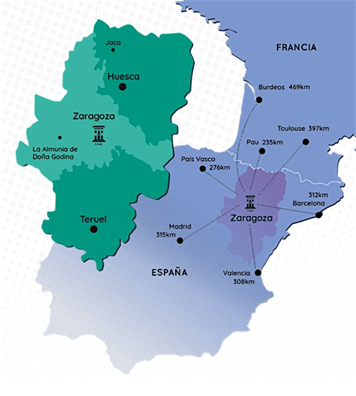
The city of Zaragoza is located in the center of the Ebro Valley depression, at a major communication junction between the plateau, the Mediterranean, and the Cantabrian regions. It is connected by road and train to the main cities of the peninsula and has several air routes with some of the major European capitals and the islands.
From Madrid:
The capital of Spain is just over 300 kilometers from Zaragoza.
By bus: There are buses almost every hour (the journey takes about 3 hours and 45 minutes by expressway). The bus station is located to the east of Madrid (metro station “Avenida de América”, lines 4, 6, 7, and 9 of the Metro). The metro network also reaches Madrid-Barajas airport. Bus company information online: ALSA. Approximate ticket price: €15.
By train: There are AVE trains that leave approximately every 60 minutes (the journey lasts between an hour and a quarter and an hour and a half). The Puerta de Atocha train station is in the center of Madrid (Metro station “Atocha Renfe”, line 1). Train schedules online: RENFE. Approximate ticket price: €40.
By car: Via the A-2 expressway (toll-free).
From Barcelona
The second largest city in Spain is also just over 300 kilometers from Zaragoza.
By bus: There are buses almost every hour (the journey takes about 3 and a half hours by motorway). The Barcelona Nord bus station is at “Arc del Trionf” (with Metro L1 stations and Urban Bus stops nearby). Bus company information online: ALSA. Approximate ticket price: €15.
By train: There are AVE trains approximately every 60 minutes (the journey lasts between an hour and a half and an hour and forty minutes). Train schedules online: RENFE. Approximate ticket price: €40.
The Barcelona airport is also connected to the train station by the Cercanías, line 1 Sants station.
By car: Via the toll motorway AP-2 or the A-2 expressway.
From Bilbao:
By bus: There are buses every two hours (4 hours journey by motorway). Online: ALSA. Approximate ticket price: €17.
By train: There are two daily trains (5 hours journey). Timetables are available online: RENFE. Approximate travel cost: €25.
By car: Toll motorway AP-68 or road with several expressway sections.
Zaragoza airport:
There are direct flights to/from:
Major European capitals: London, Paris, Brussels etc.
Balearic Islands and Canary Islands
Since June, the company Ryanair has a flight Zaragoza – Santiago de Compostela
We are happy to announce that the call for session proposals is now open. You can submit proposals for sessions you want to do yourself, but also request sessions you would like to see, and we will try to find someone to leads that session for you.
The deadline for proposal submission is
Original Deadline: Tuesday, Jan 30, 2024 New Extended Deadline: Thursday, Feb 8, 2024
The board would like to thank everyone for joining the first annual “Opencast Online Summit”. As an addition and (for some) an alternative to the in-person summit in March, this virtual meeting had introductory talks for newbies, testimonials from the daily operations of an admin as well as opportunities to raise and discuss issues. Over 90 people joined us. Thank you all.
If you could not attend, recordings are now available:
The board invites you to join the 2023 Opencast Virtual Summit on November 22 (US morning, European afternoon).
This meeting is intended as a supplement to the in-person summit with an introduction to Opencast, updates from the community and an opportunity to meet online for those who cannot or don’t like to join the March summit in Zaragoza, Spain.





 Opencast